30 May 2007

"To die would be an awfully big adventure..."

I think it’s about time to write about the current object of my affection.

Of course, I’m talking about the book I’ve been reading the past week, The Serpent and the Rainbow: A Harvard Scientist’s Astonishing Journey into the Secret Societies of Haitian Voodoo, Zombies, and Magic by an extraordinary anthropologist/ethnobotonist Wade Davis.

I first came across the topic of Haiti and voodoo society in my cultural anthropology class at OCC (I guess my interlude at community college before transferring to Berkeley paid off). I think our culture’s fascination with macabre topics like zombies and voodoo takes root in our inability to define death.

Sure, we know on a very literal level what death is. But it’s extremely hard to specifically define death; one can say that it is the cessation of the heartbeat or complete brain inactivity, but modern technology makes it hard to actually pin down the moment of death. Refer to wikipedia’s debate over death: Definition of Death

The very concept of death piques our interest because it’s a force that we cannot control. I truly believe that anything outside our human realm of control or understanding increases our culture’s obsession with it, death being one of the more controversial topics because of what follows: the afterlife, or lack thereof.

In Haiti, the vodoun religion can be placed in historical context. In 1791, Haiti was mostly populated by African-born imported slaves. In this year, the black population launched one of the few successful slave revolts in history, lead by Toussaint Louverture, in which the nation overcame the French government and established the only independent black republic in the world. (Louverture is actually a SUPER interesting character, read more about his life here: Toussaint Louverture

Haiti’s African roots were not forgotten. The Haitian peasants organized into secret societies led by vodoun priests, practicing “voodoo” rituals where individuals were able to communicate directly with the many spirits who populate the everyday world. More importantly, Haitians believe that one’s spirit and soul can be captured by a master, a bokor.

This belief is central to the creation or phenomena of zombies. Through his study of Haitian society and interactions with bokors, Wade Davis made the important distinction of how victims of zombification are chosen. In a classic example, a man named Clairvius Narcisse contacted his family 12 years after his supposed death. He had gotten into a land dispute with his brother, who clearly wanted to get him out of the way. Instead of killing him, Narcisse’s brother did something much worse: he paid a bokor to make him into a zombie.
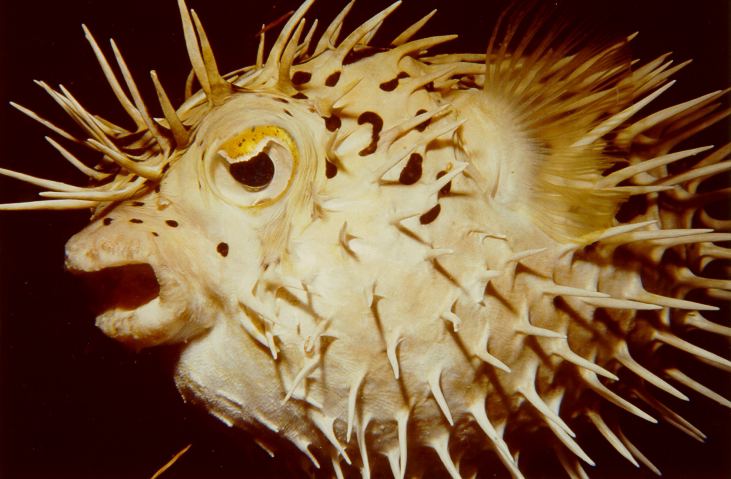
Once someone is poisoned by a bokor, their metabolic heart rate declines rapidly due to an important ingredient in the poison: tetrodotoxin, secreted in the glands of the pufferfish. Actually, in Japanese culture eating small preparations of pufferfish with tetrodotoxin has become a delicacy and a form of art. Culinary chefs have to prepare the fish with just enough of the poison to leave a tingling sensation on the tongue of the consumer, but not enough to cause any actual damage. Read more about tetrodotoxin here: Tetrodotoxin

OKAY, so the person is reduced to a near-death state, pronounced dead undoubtedly, and is buried. BUT THEY AREN’T DEAD. The bokor is able to go to their grave at night, administer a special treatment (still very ambiguous of the ingredients) to revive the person, and take them as slaves. The newly created zombie will have clearly suffered psychological brain damage due to the poisoning, and because of frequent doses of the poison administered every so often, are reduced to a trance-like state in which they cannot control their own actions and are at the whim of their master.

You see, for Haitians, slavery is much worse than death. Think about the African slave trade and the history of all the ancestors who came to Haiti seeking freedom from enslavement. In creating a zombie, the bokor is essentially able to steal the person’s free will, one of humanity’s greatest treasures.

So those like Narcisse who are ousted by their family or local criminals often suffer the fate of angry families or communities. The priests are acting in the collective interest of the village; zombies are therefore created within the social matrix of Haiti’s complex religious society. It’s fascinating to me that politicians have very little control over the citizens of their country in Haiti. Because of their fervent vodoun beliefs, people put more trust in priests and bokors than their government; and many of those with political power are also extremely reliant on the advice of religious leaders.

It’s only been recently that the creation of zombies has been acknowledged by the government of Haiti and by anthropologists around the world, perhaps in the past 20 years or so. Here’s an excerpt from Haitian Penal Code:

Article 249. It shall also be qualified as attempted murder the employment which may be made against any person of substances which, without causing actual death, produce a lethargic coma more or less prolonged. If, after the person had been buried, the act shall be considered murder no matter what result follows.

To avoid the creation of zombies, many people will pierce the heart of family members who have recently died in order to ensure that they are actually dead and cannot be brought back to life.

I guess the fear of being buried alive was a worldwide phenomenon back in the day. Wade Davis talks about Count Karnice-Karnicki, who apparently invented a device to prevent premature burials. He attended the funeral of a young girl, and just as the first pails of dirt landed on the coffin, “a pitiful scream rose from the earth.” I guess from that moment on, premature burials terrified Karnicki, and he invented a contraption made of a box and a long tube fixed into the coffin. On the chest of the dead person a glass ball was attached to a spring in the box, and if the glass ball moved (like if the person started breathing), the spring was released, initiating a chain reaction where a flag sprang above the box and a bell rang for 30 minutes. The long tube allowed oxygen into the coffin while the person inside was being saved from his or her burial.

I had NEVER heard of this device before reading the book. Obviously, you wouldn’t see one adorning many graves today, but back in the late 1800s thousands of Frenchmen left specific instructions in their wills to ensure it would be placed in their tombs, and it was so popular in the US that societies formed to promote subsidized use.

I guess premature burial is probably a fear that not many of us have today, but our fascination with the chilling reality of death still holds.

So apparently, The Serpent and the Rainbow was made into a cheesy 1988 horror film. I would advise against seeing that, and instead urge you to read the book instead: The Serpent and the Rainbow

I promise you it’s worth it.

P.S. Kudos to those who can name the source of the quote in the title of this post. :)

22 May 2007

Virgin Birth for Sharks?

After quite a long weekend of complete mayhem, I'm back.

Unfortunately, with not-so-great news for surfers and other people who like to dwell in the ocean.

It has now been confirmed that sharks can reproduce asexually.

I kid you not. Evidence: Captive Shark had "Virgin Birth"

After reading this article, I learned something I never knew before. Having sex actually increases the chances for genetic mutations to occur, meaning that species can adapt to their environment or develop new traits. But if animals are reproducing asexually, the chances of this happening are really rare. So while female sharks may be able to reproduce without finding a mate, it doesn't necessarily mean that our oceans will suddenly become as shark-infested as I might have first thought.

After looking into parthenogenesis (literally translates to "virgin birth" in Greek) I discovered that Japanese scientists were trying to use their experiment on parthenogenesis in mice to apply to humans.... see The End of Males?

Just thinking about the possibility of asexual reproduction among humans kind of fascinates me. I mean, sure, women can receive artificial insemination and become pregnant, but that sperm had to come from a guy. What happens when sperm becomes genetically reproduced??

13 May 2007

Something in the meat?

So, I noticed that something was amiss in the Oddly Enough section on Reuters. All around the mid-west, calves have been popping out of their mothers with deformities. In two recent cases, it involved one calf with six legs and another with two noses.

Case #1:
Calf Born With 6 Legs
Case #2: New Calf Has 2 Noses

Can someone please explain why this is happening? It's extremely disturbing.

Ode to my Eyesight

Earlier today, I took out my contacts and then sat at my desk to immerse myself in my studies. Some time passed, and I looked up at the clock to see what time it was. The clock is on the opposite wall of my room, roughly 12 feet away. I could not read the time.

Um, apparently I am practically blind. My eyesight has deteriorated SIGNIFICANTLY, and I haven't noticed because I wear contacts everyday. This brief panic attack made me think about my vision and the way I see the world, quite literally.

I distinctly remember when the optometrist first explained that the world around me was not supposed to be blurry. It was a problem with my vision, he explained, with the way my eyes saw the world. The remedy, of course, was glasses: small enough to fit the face of a fifth-grader. They were only meant to be worn when distance prevented me from seeing clearly; I wore them in school, at the movies, watching television. As the years passed, I grew to associate distance with chaos; the further away I was from an object, the more obscure it seemed. From 20 feet away, the face of my best friend was impossible to differentiate between the face of a stranger. If I couldn’t read the sign, it was impossible for me to follow the rules.

I remember the initial shock of realizing that not everyone saw the world this way.
I don't know if my dependency on glasses made my eyesight worse, or what. But when I first started driving at the age of fifteen, I panicked. I couldn't read street signs, and the freeway was a complete jungle.

How could my eyes betray me? How could the way I saw the world naturally not be an accurate representation of reality? I thought that it was subconscious; I could physically train myself to return to the near-perfect vision of my childhood. I regretted all those nights spent straining to read books in the dark, afraid my parents would scold me for staying up past bedtime.


I made the switch to contacts because, well, it was the law. I had to see clearly to drive. I realized instantly that wearing contacts was a way to hide my imperfection. It was kind of a secret now, no one had to know that the way I saw things was any different from the way others did.

But sometimes I rather enjoyed the weakness of my vision. It’s almost comforting to know that my surroundings can become a little softer, a little less perfect and sharp.

12 May 2007

Small Pleasures

"That man is richest whose pleasures are cheapest."
-- Henry David Thoreau

I decided to take some time out of studying to make a stream-of-consciousness list of small things that make me happy...I think it's important to dwell on the little aspects of daily life that can make or break your mood.

Here I go.

- Solid water pressure in the shower. Honestly, I think this is one of the most under appreciated things in life. Weak showers are just unacceptable.

- The satisfaction you feel after doing laundry. Don't know if it's because I'm proud of the fact I haven't fucked it up, or it amuses me that everyone tells me I have to separate my whites and darks and I don't
and I truly enjoy small rebellions like that. (Nothing traumatizing has ever happened to my clothes -- they are either very durable or I've just been lucky)

- When you make eye contact with a complete stranger and can smile and acknowledge each other's existence. This happened to me today walking across the street, some random person and I recognized the presence of another human being and smiled at each other. It makes me super sad when I think that people just walk around absorbed in their own worlds, with either their iPod or cell phone permanently attached to their heads. There's this quote from the movie "Waking Life" that I like:

I know we haven't met, but I don't want to be an ant. You know? I mean, it's like we go through life with our antennas bouncing off one another, continuously on ant autopilot, with nothing really human required of us. Stop. Go. Walk here. Drive there. All action basically for survival. All communication simply to keep this ant colony buzzing along in an efficient, polite manner. "Here's your change." "Paper or plastic?' "Credit or debit?" "You want ketchup with that?" I don't want a straw. I want real human moments. I want to see you. I want you to see me. I don't want to give that up. I don't want to be ant, you know?

- The way steam curls up from a hot cup of tea. I know it sounds bizarre, but I really like watching it, it relaxes me.

- Writing with Sharpie markers. It's really satisfying.

- Appreciating the time of day right after the sun sets, but before it becomes night (best time ever)

- Waking up before your alarm goes off so you can just chill in bed without worrying about oversleeping

- Having someone tell me they've already read a book that I recommend to them...it makes me feel like I know the person well enough to judge what they'd like!

- When unexpected friends call you and say that they were just thinking about you and want to know what you're doing...because normally when people call out-of-the-blue there is a specific reason or request behind the call.

- Getting a letter from my pen pal(s)

- Making to-do lists, and then crossing out everything on it before throwing it away

- Not losing my keys in the morning (this is a very, very rare occurrence, and thus it makes me happy when I can actually find them the first time around)

- When I know more about what's happened in the world than my mom and can fill her in on the news (another rare occurrence to be savored)

- Aesthetically pleasing things in general

- Hearing other people use words that I enjoy tremendously, such as "glisten," "nefarious," "tomfoolery," "nonsense," "deliberate," "mischievous," "retrospectively," "shenanigan," "exceptional," and "certainly." Just say those words out loud, they are incredibly enjoyable.


I think I made my point. Studytime awaits!

10 May 2007

Not Your Average Breakfast

Something has gone awry at the local grocery store in Suffolk, UK. It appears that a chick can be hatched from eggs bought at the supermarket. Hmm. I'm pretty sure you're supposed to eat those eggs, not use them to hatch chickens.

Read on:Chick Hatches from Shop Egg


This brings up a lot of questions for me. As an occasional egg-eater and carnivore myself, it makes me VERY wary of the eggs I'm going to purchase in the future. I mean, if potential chicks could be hatched from them, I'm not too sure how I feel about scrambling them with bacon.

Then again, I guess all the eggs you buy could have been potential chickens no matter what. Any animal product you buy and eat, in that sense. I think this egg-hatching has just thrown everything off for me. Cute furry baby chicks....or delicious fried eggs?

I CAN'T DECIDE.


Transvestite Killers Run Free...

...in Chile. It just came to my attention that the justice system in Chile is practically moot. Take, for example, the case of Andrea Sanchez.

Sanchez, a transvestite, was found brutally murdered in her (his? I don't know what is politically correct anymore) apartment November 2004. The man who killed her was arrested at the scene of the crime -- a pretty easy case to bring to court. Victor Vicencio Marin (the murderer) spent 3 nights in jail before paying $1,000 and being released.

The case has been going on for two and a half years, even though Vicencio admitted guilt. Sanchez's mother has been struggling to pay for lawyers to keep Vicencio in jail, but to no avail. Last month, court reached the following decision: Vicencio has a 4-year suspended sentence unless he commits another crime.

HE DOESN'T EVEN GO TO JAIL. Does anyone else see something wrong with this? You have a confessed killer, all the evidence, and yet... no jailtime.

Apparently, this is not just a one-time case in Chile. Transvestites aren't very tolerated and have become a prime target for excessive and unnecessary violence. Eleven crimes similar to Sanchez's murder have taken place since 2002, and not one of the murderers has gone to jail.

Click here for the full story: Confessed Transvestite Killer Avoids Jail


09 May 2007

Open Forum & Closed Cages

I have recently mended my erroneous ways and opened up posting for non-registered users, which means anyone is free to contradict or agree with me!

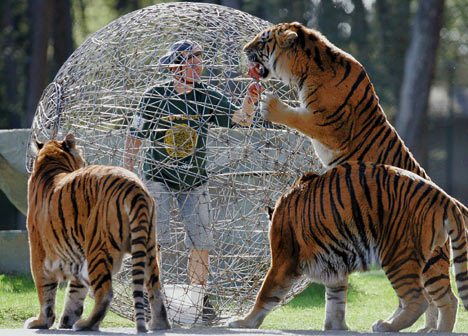
Meanwhile, in other parts of the world, certain people decided it would be fun to enclose themselves in a cage surrounded by angry felines.

Observe.


This was only one "stop" for German performance artist Arnd Drossel, who was on a 220-mile roll through the German state of North-Rhine Westphalia to raise money for psychiatric patients. To quote:

He accepts that some observers will judge him 'a stripe short of a tiger' for including this particular area of the Stukenbrock Safari Park on his route.

But he insists his protective capsule - 250 high-grade steel strands welded into something resembling a massive ball of wool - is strong enough to keep him safe. Drossel, 38, who designs furniture for a living when not suffering for his art, will eat, sleep and move in the ball.

He propels it by simply shifting his weight in a walking motion, and aims to cover 13 miles a day.

'I got the idea for this because, about a year ago, I hit a low and
realised how little help there was out there,' he said.

'I set about thinking of a way to publicize those who need psychiatric help and came up with this.

'Basically, the whole concept is about finding the courage to do something and inspire courage in those who have lost their confidence along with much else.'


[Thank you thisislondon.co.uk
]


07 May 2007

Public Transportation & the Collective


I often witness public transportation -- buses, planes overhead, BART, trains -- and think about how underanalyzed it is. Public places are a favorite source of entertainment for the people-watcher at heart, and I have found that public transport sets the stage for an interesting assortment of situations and combinations, leaving much to the imagination.

It's very rare that you find yourself on a bus or plane where everyone is silent. More
often than not, you overhear things you wish you hadn't, or maybe wish you heard more of. How many cell phone arguments, sketchy conversations, or outright ridiculous scenarios have you come across while on the bus? For me personally, the answer is more than I can count.

Growing up, I never took public transport save airplanes. Buses in Irvine were out of the question -- a social suicide of sorts -- limiting my experience to airplanes. I became fascinated with the microcosm of society that existed, all the life stories that unfolded from take-off to landing.

I couldn't edge away from that tugging feeling that while on-board, we were all apart of a mysterious trick-of-the-eye; that perhaps the passengers were somehow apart of a collective. After all, when seen from below, everyone is apart of the machine -- every passenger sits in its belly, their identity hidden by great hulks of metal. We are all arriving at the same destination, anticipating what lay before us as the wheels slide across the runway. Our individuality, is, of course, retained by who we are and what will become of us once we step off the plane.

Comparatively, a bus is composed of an ebb and flow in passengers. People get on at a different stop, get off at another, and the sense of unity felt in an airplane is almost absent. One of the similarities, of course, is that we give up a little of our freedom when stepping onto a vehicle of public transport. Our paths are at the mercy of others: bus drivers, captains, train conductors. A mutual, unspoken trust is formed whenever the ride begins -- the passengers abide by certain rules and the drivers will fulfill our need to arrive safely.

Whenever I take the bus (or fly on a plane for that matter) I always like to wonder about the people around me -- where they are coming from, where they are going. It's nice to know that for a brief period of time, whether it be suspended in midair or on a city street -- you can share something tangible with strangers.

05 May 2007

A Hybrid Humanity

In a recent bout of procrastination, I turned to a trusted source for distraction: The Secret Language of Symbols (a book I purchased recently for the whopping sum of $2.50 at Pegasus Bookstore). Turning to a chapter I had not yet read, I began to immerse myself in the world of hybrid creatures. To quote:

Hybrid creatures have two main functions: they bring together the symbolic strengths of different animal, and they represent the fundamental unity of existence. They carry a positive symbolic meaning; they inhabit a dimension that spanned this, and other worlds, and thus could serve not only to help mankind in the struggle against dark forces but also to act as messengers from the gods and as sources of wisdom in themselves. To the minds that invented them, hybrids presented no inherent contradictions, because if all creation was interconnected, there was no reason why certain ingredients should not be permutated in new and different ways. There is much evidence that the ancients did not separate imagination and reality in the way that is habitual to us. If something could be imagined, there was a sense in which it must really exist.


I’m wondering if humans have become hybrid creatures. Taking the thread of my last entry, and also Sean’s comment to that post, I was struck with the thought that perhaps technology has become an extension of human existence. We define ourselves through the technology we use, express ourselves creatively (hello, blogs), solidify friendships, make plans, educate ourselves (and yes, I include wikipedia among that category)… it seems like every aspect of human behavior, even down to sex (cyber, anyone?), can be technologized.

In a book I re-read recently – Anthem by Ayn Rand – the world has somersaulted into the future losing technology and the concept of individuality. Humans work physically and mentally to survive, absent electricity/machines/etc. One man treads debaucherous territory when he discovers, randomly, the power of electricity flowing through two connected wires. Through his discovery, he redefines himself and consequently establishes the idea of the “ego”.

I found it both interesting and poignant that Rand illustrates the power of humans to assert individuality through the discovery of technology – but it makes complete sense when you think our current situation. Written in 1937, the world had not yet spiraled into what it is today, but her allusion to a future where we define ourselves through the technology we use still holds strong.

Take, for example, the “Get Chipped!” campaign run by Applied Digital Solutions – the implant of computer identification chips in our bodies (a non-reversible process). Not only are people getting their dogs chipped, but they have now introduced the possibility to implant a computer chip in your newborn baby.

The chip is pictured below:


Their website Get Chipped! explains that it would prevent baby-switching in hospitals, provide patient identification in emergency situations, and apparently to prevent residents in old-age homes from “wandering off”… hmm. A device that could track where you are, who you are, in any location globally? Sounds like we’re entering into a Brave New World indeed.


I’m a little scared, to tell you the truth.